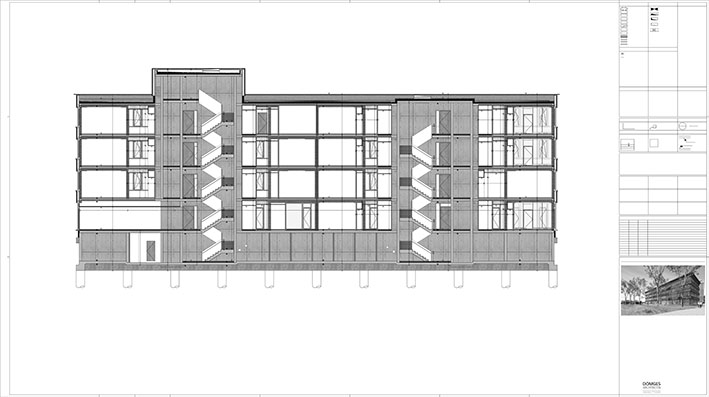
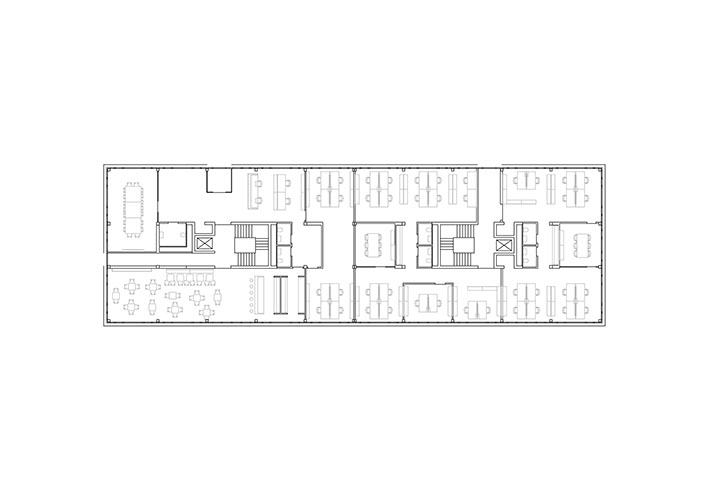
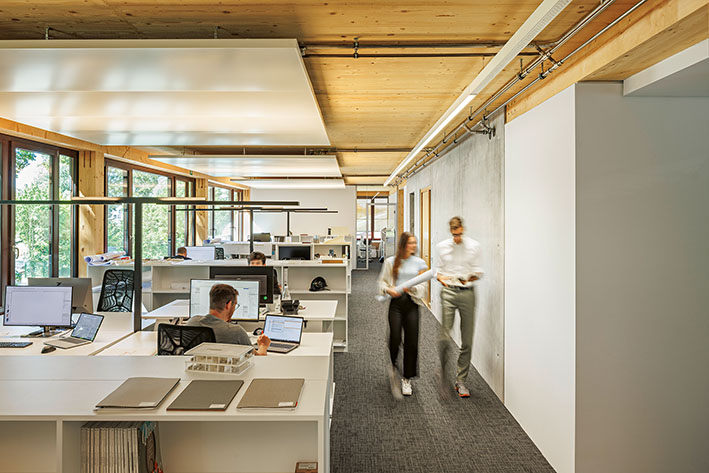
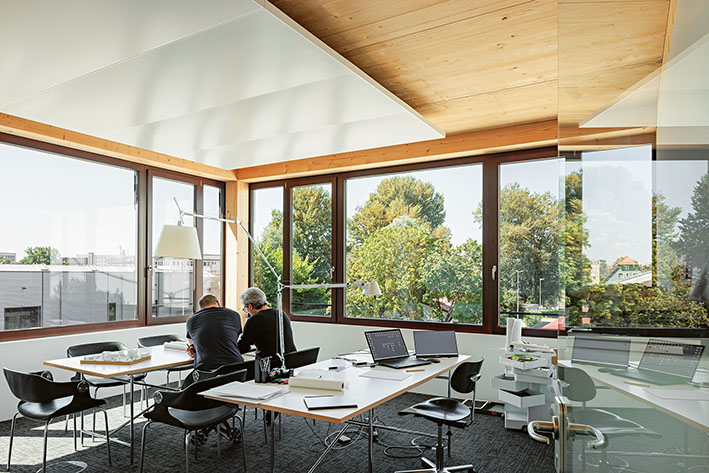
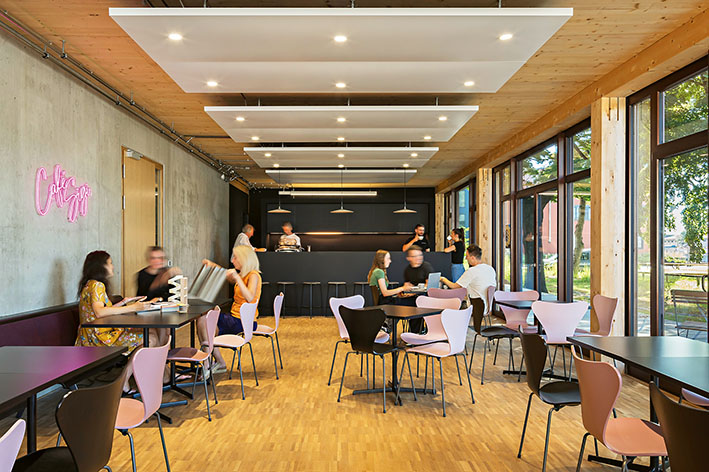
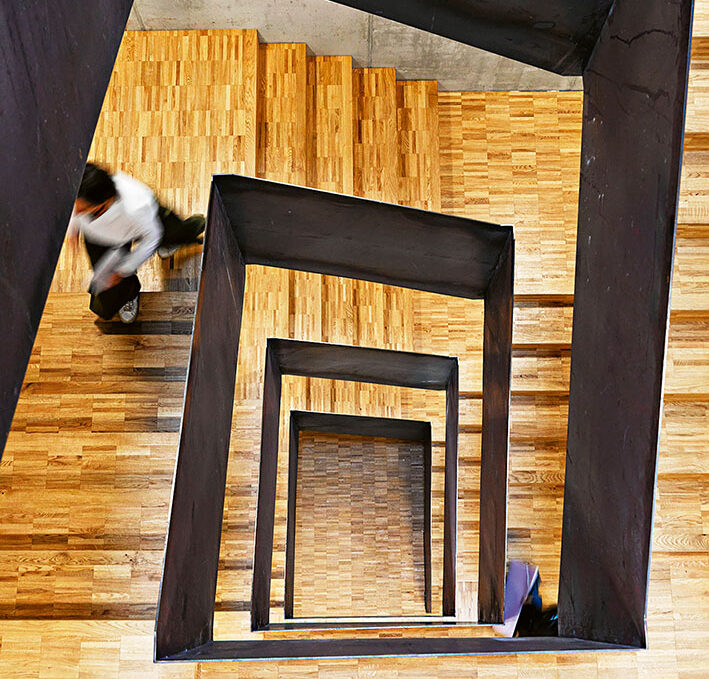
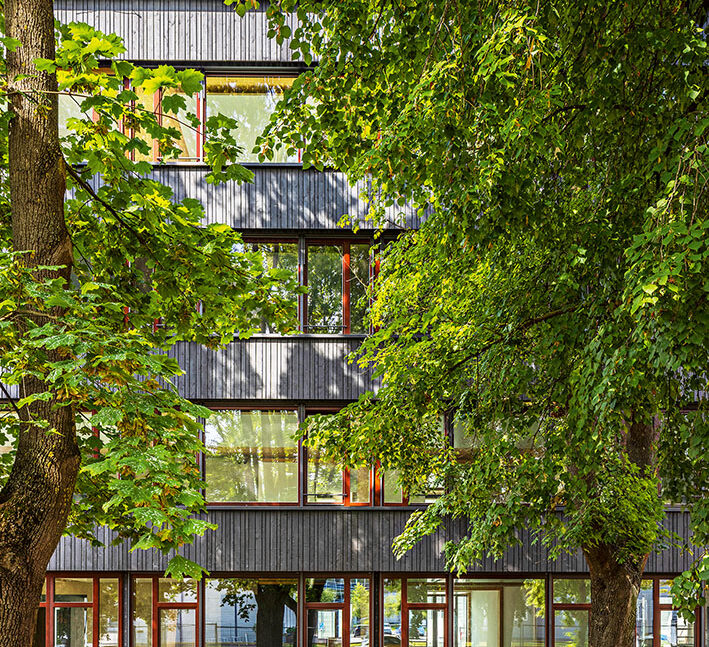
It’s a place to relax briefly, get some fresh air, or wind down a productive day together in the evening. In front of the building, the raw charm of a harbor setting unfolds beneath old trees. Or one can stay inside and enjoy an espresso at “Café Sigi.” The new building is a sustainably constructed timber hybrid office building — an architecture designed for the future, exemplary in terms of energy performance, climate responsiveness, and life-cycle considerations. Heating and cooling are provided via groundwater heat exchangers, while acoustically effective heating and cooling ceiling sails openly display the building’s technical systems. Of the total, 3,756 square meters of office space in the eastern part of the building are available for rental. The structure is a four-story timber skeleton construction with hybrid timber ceilings. The façades are built using timber frame construction, while the basement and the two stair cores are executed in exposed concrete. The offices, where desk groups are arranged along the windows, are naturally ventilated. Material-rich surfaces with a pleasant tactile quality — wood and exposed concrete — define the interior. Outside, rough-sawn timber slats and glass give the otherwise restrained building volume texture and structure. Its appearance is clearly organized, with a calm façade articulated by continuous horizontal parapets. An honest, material-driven atmosphere emerges: black timber façades, reddish-brown wooden window frames, and sun-yellow awnings on the exterior; exposed concrete, raw steel railings, and wood surfaces inside. The architectural philosophy of the office is reflected in the building concept. Central to this is the unity of function and construction, as well as the pursuit of simple, coherent, and aesthetically clear solutions — both in the overall design and in the details. A limited number of simple components were deliberately used. The interior design is shaped by demountable constructions and flexible spatial configurations, allowing for different uses. This supports the facilitation of interdisciplinary collaboration as a future mode of working — New Work.