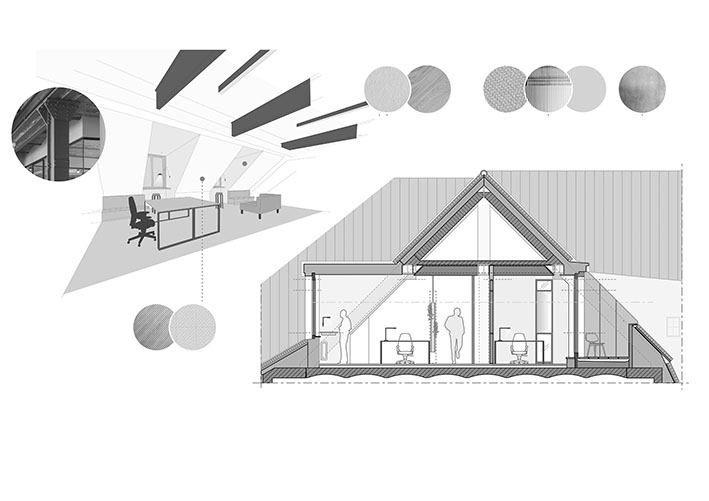
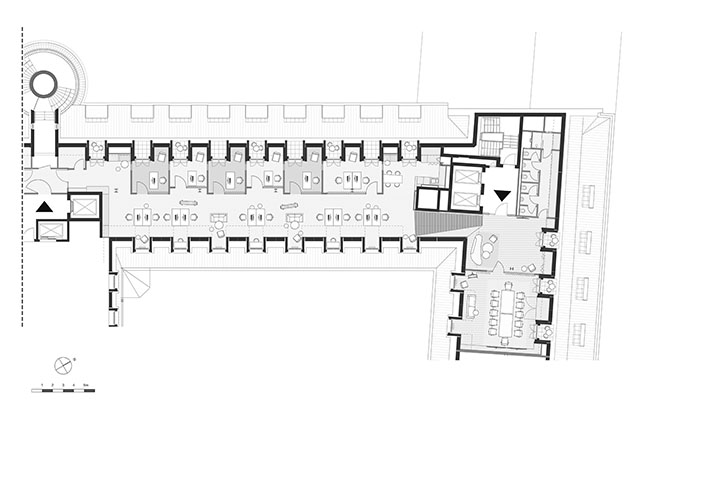
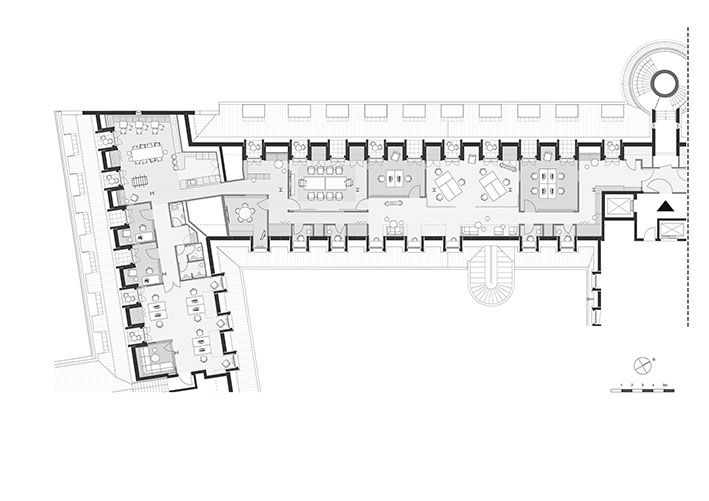
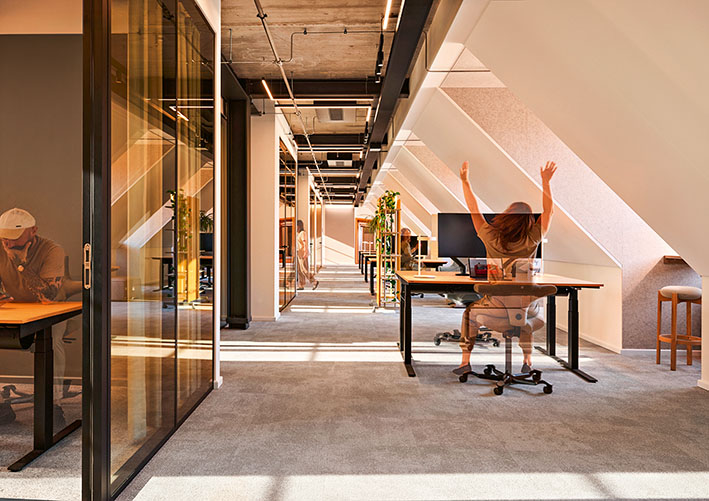
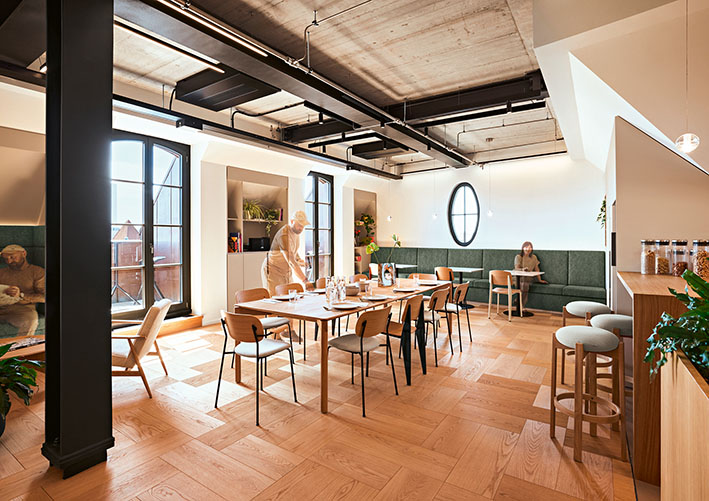
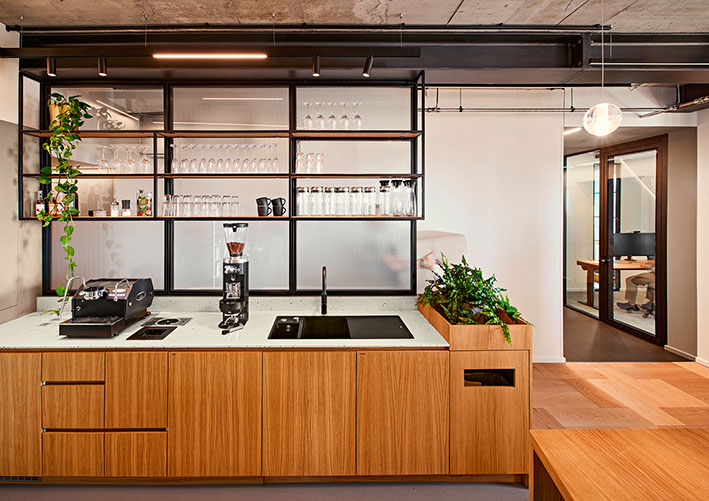
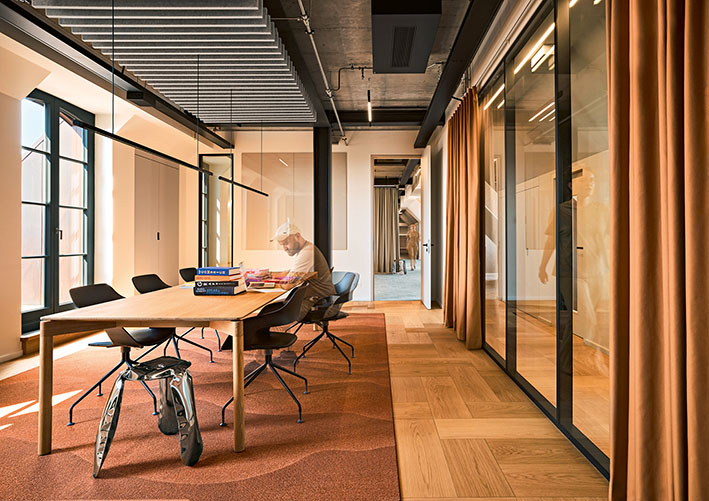
Here, the distinctive form of the striking pitched roofs, along with integrated dormers and loggias, provides significant support to the designers — de Winder Architekten in this case — in developing an individual and atmospheric architecture. Of course, this requires sensitivity, expertise in dealing with insulation, light guidance, and so on, as well as an appreciation for more complex volumetric forms. The concept follows the idea of creating a kind of topography in which the working environment can unfold. A village-like narrative is developed, assigning each function and space a characteristic sense of place. From a dramaturgical perspective, the aim is for users to feel, within the office landscape, somewhat as if they were in a public square, on a path, or in a private retreat. This enhances the appeal of collaboration and interaction. For example, there is a tunnel between two work areas that, through perspectival distortion, intensifies the perception of movement and activity within the workspace. The combination of open zones and the spatial presence of dormers cut into the sloping roof makes this floor more engaging than a typical loft situation. This is further reinforced by the noticeable contrast in materiality: on the one hand, the deliberately preserved raw structure with exposed concrete ceilings and visible beams or columns; on the other, the delicate glass walls and refined interior detailing. The lighting concept emphasizes variety, with linear fixtures in the dormers, orthogonal L-shaped lights on the reinforced concrete ceiling, and individual desk and object lighting.